You're seeing the headlines about "China Plus One" and hearing that some suppliers are opening factories in Vietnam to avoid tariffs. But you're also hearing rumors of quality nightmares and broken supply chains. It’s a huge risk to move your multi-million dollar account based on a trend.
For large-scale, quality-focused importers, China remains the superior choice. Many new Vietnamese factories lack the mature supply chain, skilled labor, and deep expertise of established Chinese manufacturers, often resulting in higher hidden costs, inconsistent quality, and greater overall risk.
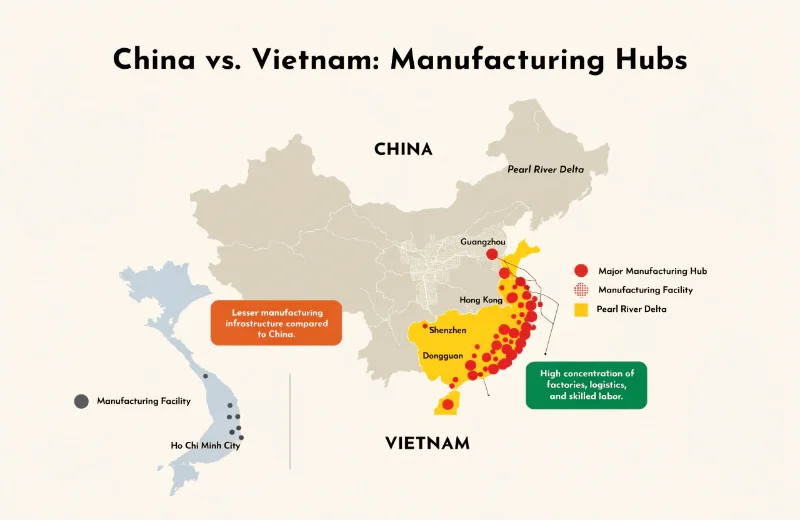
Every week, I get this question from purchasing managers I've known for years. They see a competitor announce a "Made in Vietnam" line and get nervous. They ask me, "Elio, are we missing out? Should we be looking at Vietnam?" My answer is always based on the hard realities of mass production. The promise of Vietnam is tempting, but the operational advantages of China's mature manufacturing ecosystem are, for now, irreplaceable for serious buyers. Let's break down the real-world differences I see on the ground.
Is Vietnam Really the Cheaper Option for Frame Manufacturing?
You received a quote from a Vietnamese factory that seems 10% cheaper. But are you accounting for hidden costs in materials, logistics, and efficiency that could erase those savings and more?
No, it's often more expensive in total. While direct labor costs may be lower, Vietnam's reliance on imported raw materials (often from China), less efficient logistics, and lower worker productivity frequently lead to a higher final landed cost than a quote from a mature Chinese factory.
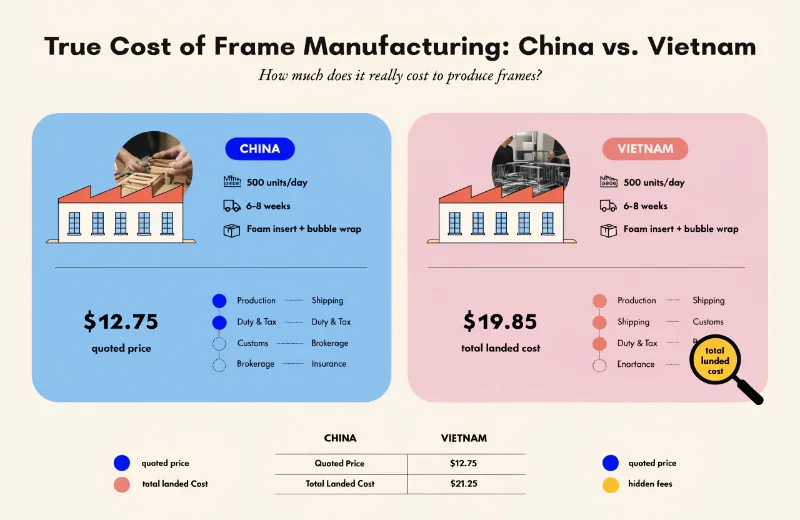
A client, a manager for a major European wholesaler, recently showed me a price list from a new factory in Vietnam. On paper, their standard 8x10 MDF frame was cheaper. But I asked him, "Where do they get their MDF? Their paper foil? Their glass?" The truth is, Vietnam does not have a mature industrial base for these materials. They import them, and a huge portion comes directly from China. This means you are paying for shipping and tariffs on the raw materials before the frame is even made.
The established manufacturing hubs in China, like the Pearl River Delta, are a complete ecosystem. Within a 50-kilometer radius of our factory, I have hundreds of suppliers for every component imaginable, all competing on price and quality. This deep, localized supply chain is something Vietnam is decades away from achieving. When you add the lower labor efficiency and higher defect rates[^1] that come with an inexperienced workforce, the initial "savings" in Vietnam quickly disappear.
| Cost Factor | China (Mature Factory) | Vietnam (New Factory) | Winner for Buyer |
|---|---|---|---|
| Labor Cost | Higher per hour | Lower per hour | Vietnam (on paper) |
| Material Cost | Low (local supply) | High (imported) | China |
| Efficiency | High (skilled workers) | Low (inexperienced workers) | China |
| Total Landed Cost | Lower | Higher | China |
Can Vietnamese Factories Match China's Quality and Expertise?
Your brand reputation depends on flawless quality across 100,000 units. Can a new factory with an untrained workforce deliver the same consistency as a Chinese supplier with 30 years of experience?
No, this is the biggest risk. China has a deep pool of experienced engineers, production managers, and QC staff who have been making frames for decades. Many "Vietnamese" factories are just assembly workshops with inexperienced labor, leading to high defect rates and inconsistent quality.
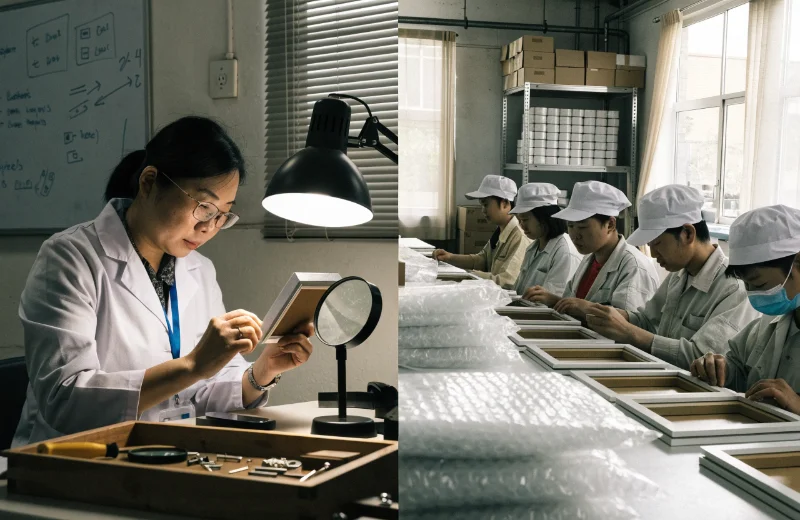
This is the point I stress the most with my clients. A photo frame looks simple, but making 100,000 of them perfectly is incredibly complex. It requires what I call "production wisdom"—the kind of knowledge that only comes from experience. I remember visiting a Chinese-owned factory in Vietnam that was trying to recruit our business. The factory floor was new, but the workers were struggling. They were using the wrong pressure for the wrapping machine, causing tiny bubbles on the frame's surface. Their corner joints had minute gaps. These are small mistakes that an experienced Chinese line worker would spot and fix instantly.
Many of these new factories in Vietnam are what we call "shell factories." A Chinese boss might set up a small final-assembly plant in Vietnam to get the "Made in Vietnam" label for tariff reasons, but the core components and expertise are still missing. They lack the experienced middle management—the line supervisors and QC chiefs with 5+ years of experience that we have on every line—who are the true guardians of quality. For a large brand, where a 1% defect rate means thousands of bad units reaching customers, this risk is simply too high.
How Stable is Vietnam's Supply Chain Compared to China's?
A delay on a single component, like your custom packaging, can halt your entire shipment. How can you trust a supply chain that depends on importing its own parts from another country?
Vietnam's supply chain is fragile and dependent, making it a high-risk choice. China's is a fully integrated, resilient ecosystem. Everything from raw materials to custom packaging is available within days, not weeks, ensuring your production runs on time and on budget.
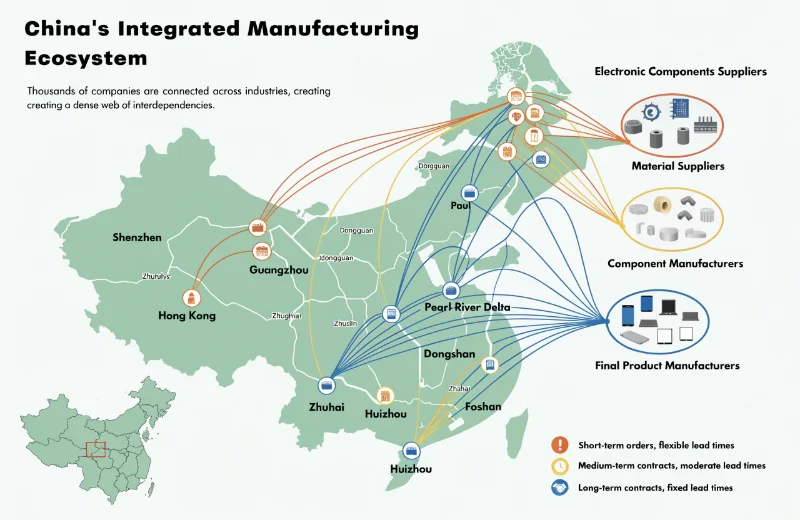
Let me give you a real-world example. One of my clients, a large US retailer, needed a custom-designed gift box[^2] for their holiday frame collection. They needed 200,000 units, and the design was complex. Here in Dongguan, China, I was able to get physical samples from three different high-quality packaging suppliers within 48 hours. We chose a supplier, and the full order of boxes was delivered to our factory in two weeks. Now, imagine trying to do that from Vietnam. The factory would first have to source a supplier, who would likely have to import the high-grade cardboard (probably from China), then set up for production. The lead time would be months, not weeks.
This is the power of China's manufacturing ecosystem. It's not just about our factory; it's about the entire network. Raw MDF boards, custom-cut glass, hundreds of paper foil designs, metal hardware, and every type of packaging you can imagine—it's all here, clustered together. This density creates incredible speed, flexibility, and reliability. If one supplier has an issue, I have ten others I can call. In Vietnam, if the single importer for a specific component has a delay, your entire production line stops. For a purchasing manager whose job is to minimize risk and ensure on-time delivery, the choice is clear.
Conclusion
For large-scale frame orders, China's integrated supply chain and expert workforce provide a lower-risk, more reliable, and ultimately more cost-effective solution than the emerging but immature Vietnamese market.
---

[^1]: "Nike in Vietnam - The Tae Kwang Vina Factory", https://documents1.worldbank.org/curated/en/915561468329376238/pdf/514330WP0VN0Ni10Box342028B01PUBLIC1.pdf. Defect rates in Vietnamese manufacturing are often higher due to less experienced labor and newer facilities. Evidence role: statistic; source type: research. Supports: Vietnamese factories have higher defect rates compared to Chinese factories.. Scope note: Defect rates can vary depending on the specific factory and product type.
[^2]: "Folding Gift Boxes from China", https://www.usitc.gov/sites/default/files/publications/701_731/pub5471.pdf. China's manufacturing ecosystem enables rapid sourcing and production of custom-designed packaging, reducing lead times. Evidence role: case_reference; source type: institution. Supports: China's manufacturing ecosystem allows for faster production of custom-designed packaging compared to Vietnam.. Scope note: The example may not generalize to all types of packaging or industries.