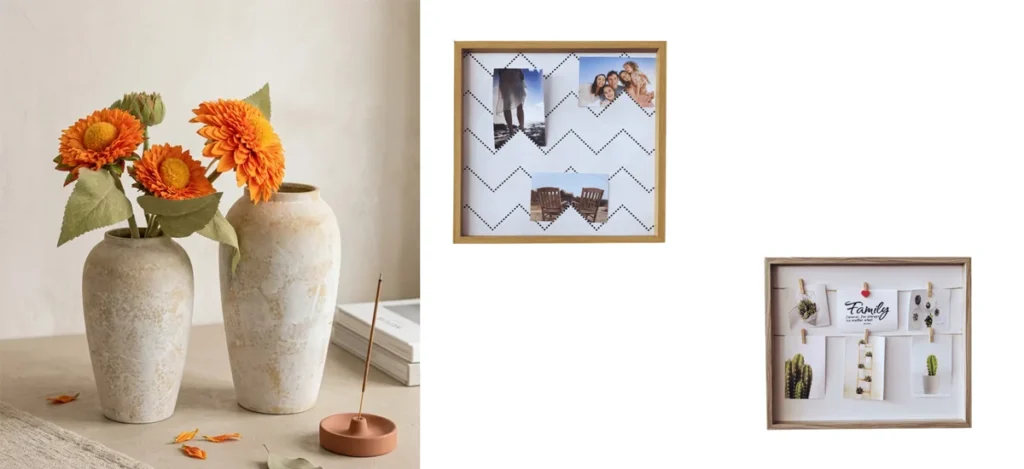
You need high-quality frames for a large order. Solid wood is too expensive, and plastic feels cheap. You are caught between hitting a price point and delivering a quality product.
An MDF photo frame is an engineered wood product made from wood fibers, resin, and wax. It offers the consistent quality and premium look of wood at a much lower cost, making it the ideal material for scalable, high-volume manufacturing.
I talk to purchasing managers every day, and this is a constant challenge for them. They need to source products that look great on the shelf but also fit within a tight budget for a huge retail program. For over ten years, MDF has been the core of our business for this exact reason. It's the material that allows us to tell a major US retailer, "Yes, we can produce 200,000 rustic farmhouse frames that look incredible and meet your target cost." It’s the perfect solution to the quality vs. cost problem.
How Exactly Is an MDF Photo Frame Made?
You see "MDF" on a spec sheet, but you're not sure what it is. You worry it's just a fancy name for cheap particle board that will disappoint your customers.
MDF, or Medium-Density Fiberboard, is not particle board.[^1] It is an engineered wood composite made by breaking down wood into fine fibers, mixing them with resin, and pressing them under high heat. This creates a dense, stable, and perfectly uniform board.
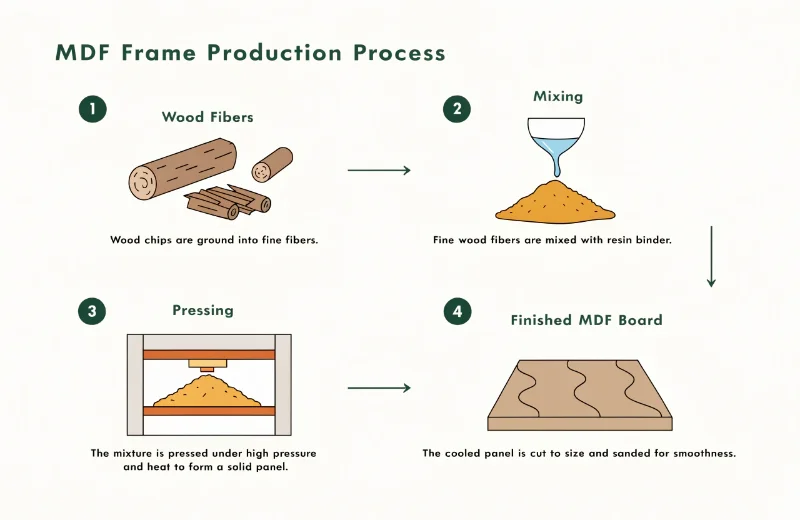
The beauty of MDF is in the process. It's about engineering a better, more consistent material than nature can provide. In our factory, we have this down to a science. The consistency of MDF is what allows our automated machinery to cut thousands of profiles with perfect precision, day in and day out. It's a process designed for quality at scale, turning raw wood residuals into a high-performance product.
The Manufacturing Journey of an MDF Frame
The process is systematic and controlled, which is why it's perfect for large orders that require consistency.
-
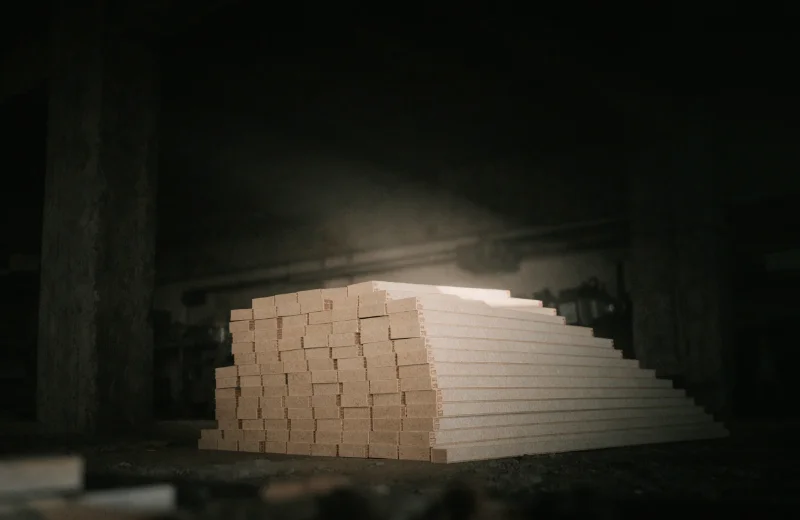
Creating the Board: It starts with wood residuals, like sawdust and shavings. These are broken down into uniform fibers. This is a great use of materials that would otherwise be wasted. These fibers are then mixed with a resin binder and wax. This mixture is pressed under intense heat and pressure to form a solid, dense board.
-
Milling the Profile: The large MDF boards are then cut into long strips. These strips are fed into a milling machine that cuts the desired shape of the frame, known as the profile. Because MDF has no knots or grain, every single piece comes out perfectly smooth and identical.[^2]
-
Applying the Finish: The magic happens here. The raw MDF profile is usually wrapped in a specialized decorative paper. This paper can be printed with any design imaginable—from a hyper-realistic oak grain to a solid color or a custom pattern. The paper is laminated onto the profile using heat and adhesive for a durable, beautiful finish.
| Step | Process | Result |
|---|---|---|
| 1. Formation | Wood fibers are mixed with resin and pressed. | A dense, stable, and uniform board. |
| 2. Milling | The board is cut into a specific frame shape. | A perfectly smooth and consistent profile. |
| 3. Finishing | A decorative paper wrap is applied. | A beautiful, durable, and customized finish. |
Why Choose MDF Over Solid Wood or Plastic?
You're comparing quotes. Solid wood is premium but eats your margin. Plastic (PS) is cheap but can feel light and flimsy. You're trying to find the best value for your market.
MDF provides the best balance of cost, quality, and aesthetics. It has the substantial feel of wood without the high price or risk of warping. It offers a more premium finish and weight than plastic, hitting the sweet spot for many markets.
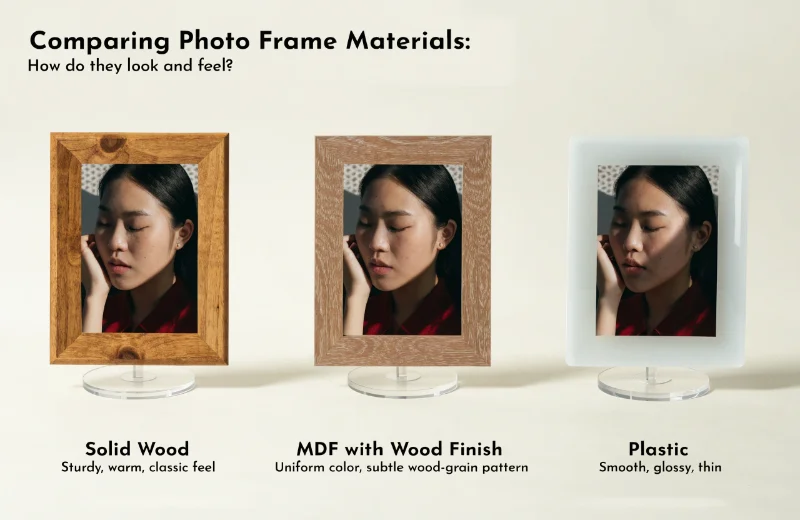
As a manufacturer of both MDF and PS frames, we guide our clients to the right choice based on their specific needs. A client looking for bathroom decor might choose PS for its moisture resistance. But for a living room gallery wall, MDF is almost always the winner. When a buyer for a major department store holds our oak-finish MDF frame, they feel the weight and see the realistic grain. They get the look and feel they want, and I can give them a price that makes their program profitable.
A Head-to-Head Comparison
For a purchasing manager, the decision comes down to clear advantages. Here’s how they stack up for large-scale production.
-
MDF vs. Solid Wood: The biggest differences are cost and consistency. Solid wood is much more expensive and can have natural imperfections like knots.[^3] It can also warp or crack in different humidity levels. MDF is more affordable and completely stable, ensuring every frame in a 100,000-piece order is identical.[^4]
-
MDF vs. Plastic (PS): MDF feels heavier and more substantial, giving it a higher perceived value. While PS molding technology is good, high-fidelity paper wrapping on MDF can often achieve more realistic and textured finishes, especially for wood grains. PS is lighter, which can save on shipping, but MDF's weight communicates quality to the end consumer.
| Feature | MDF Frame | Solid Wood Frame | Plastic (PS) Frame |
|---|---|---|---|
| Cost | Medium | High | Low |
| Consistency | Excellent | Varies (knots, grain) | Excellent |
| Stability | Excellent (resists warping) | Fair (can warp/crack) | Excellent |
| Perceived Value | High | Highest | Medium-Low |
| Finish Options | Nearly Unlimited | Limited by wood type | Wide, but can look artificial |
What Makes MDF Frames So Easy to Customize?
Your brand needs a unique look to stand out. You want to offer a special collection for the holidays or a specific style for your target customer, but custom development seems slow and expensive.
MDF's perfectly smooth surface is the ideal canvas for high-fidelity paper wraps. This allows for endless finishes—from realistic wood grains to custom brand colors—to be applied to a standard frame profile, offering massive variety with minimal tooling costs.
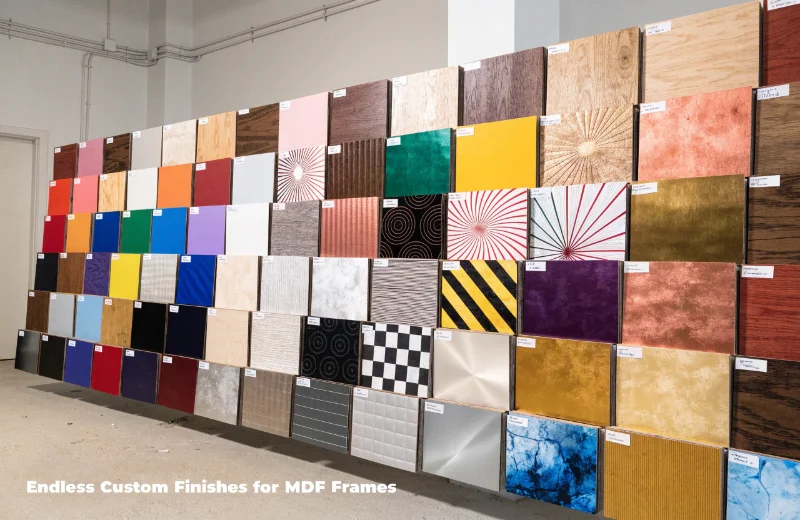
This is where we have the most fun with our OEM clients. A brand manager will come to us with a mood board for their next season. Because of our expertise in paper wrapping MDF, we can say "yes" to almost anything. We once matched a specific "rustic barnwood" look for a major American retailer's farmhouse collection. For a European client, we developed a "light Scandinavian oak" that became their bestseller. This flexibility is only possible because MDF provides such a reliable and receptive base material.
The Power of the Paper Wrap
Customization is what turns a generic product into a branded bestseller. With MDF, this is simple, fast, and cost-effective.
-
Unlimited Finishes: The decorative paper can be printed with any design. This means we can create a photo frame that looks like oak, walnut, pine, or even exotic woods. We can match any Pantone color for a bold, modern look. We can print patterns, textures, or even branded logos directly onto the finish.
-
Low Development Cost: Creating a new look doesn't require creating a new mold or sourcing a new type of wood. It simply requires printing a new paper design. This allows brands to test new styles or launch limited editions without a huge financial commitment.
-
Fast Turnaround: Once a paper design is approved, applying it to our standard MDF profiles is a fast and efficient process. This allows us to quickly move from concept to mass production, helping our clients respond to market trends faster than their competitors.
Conclusion
MDF frames offer a cost-effective, stable, and incredibly versatile solution for mass production, delivering the premium look of wood with nearly limitless options for customization and brand differentiation.
---

[^1]: "Why do people fear particle board and MDF? : r/woodworking", https://www.reddit.com/r/woodworking/comments/b0c1yz/why_do_people_fear_particle_board_and_mdf/. This source defines MDF and distinguishes it from particle board, explaining its composition and manufacturing process. Evidence role: definition; source type: encyclopedia. Supports: MDF, or Medium-Density Fiberboard, is not particle board..
[^2]: "How MDF Is Made From 600–800 Kg of Wood Fiber Per ...", https://www.youtube.com/watch?v=WFjXevQ2t1g. This source explains how the absence of knots and grain in MDF contributes to its smoothness and uniformity. Evidence role: mechanism; source type: education. Supports: Because MDF has no knots or grain, every single piece comes out perfectly smooth and identical.. Scope note: Uniformity may depend on the quality of the raw materials used in MDF production.
[^3]: "Common wood defects 🪵 I used to shy away from any ...", https://www.facebook.com/EdElliottSculpture/posts/common-wood-defects-i-used-to-shy-away-from-any-defects-and-want-clean-sound-pie/1541728211291673/. This source discusses the cost and natural imperfections of solid wood compared to engineered materials like MDF. Evidence role: statistic; source type: education. Supports: Solid wood is much more expensive and can have natural imperfections like knots.. Scope note: Cost differences may vary by region and wood type.
[^4]: "MDF Board Manufacturing Cost Analysis & Profit Insights", https://www.imarcgroup.com/insight/mdf-board-manufacturing-cost-analysis. This source supports the claim that MDF is cost-effective and stable for large-scale production, ensuring uniformity. Evidence role: mechanism; source type: institution. Supports: MDF is more affordable and completely stable, ensuring every frame in a 100,000-piece order is identical.. Scope note: Uniformity may depend on the specific manufacturing standards and equipment used.